

Table of Contents
- What Is Elemental Magnesium and Why Is It the Only Number on Your Label That Matters
- 1000 mg of Magnesium Glycinate, or is it really oxide?
- Why magnesium needs a “carrier”
- Different forms of magnesium and how much elemental magnesium to carrier
- Why the term "bioavailability" is a marketing gimmick from the magnesium industry
- Magnesium Absorbability: You absorb more magnesium from oxide than from magnesium citrate.
- Glycinate vs Oxide
- Magnesium Blood Tests
- Magnesium labels are lying to you
- Magnesium labelling
- How much magnesium you actually need, and how much is too much
- How to check your magnesium label
- My final thoughts on magnesium
- FAQs
What Is Elemental Magnesium and Why Is It the Only Number on Your Label That Matters
1000 mg of Magnesium Glycinate, or is it really oxide?
Pick up almost any magnesium bottle and the front label will boast a big number, "1000mg Magnesium Bisglycinate," "500mg Magnesium Citrate." That number is not the amount of elemental magnesium in the capsule. It's the total mass of the whole compound: the magnesium atom plus whatever it's bonded to (glycine, citrate, oxide, and so on) — not the elemental magnesium content itself.
The number that actually tells you how much magnesium you're getting is the elemental magnesium figure, the amount of the magnesium alone, stripped of the compound i.e. glycine or malic acid it is bound to. Under EU and UK food supplement law, this is also the only figure brands are legally required to state as "magnesium" on the Nutrition Information panel¹ ². Everything else on the front of the pack is, technically, decoration.
If a label doesn't make this number obvious and you're having to do the maths yourself, then it’s likely the company is hiding magnesium oxide in their magnesium supplement.
Why magnesium needs a “carrier”
Elemental magnesium is never sold on its own. If you consumed pure magnesium, the metal would react aggressively with the hydrochloric acid in your stomach, producing hydrogen gas, which would cause stomach pain and gas.
As a mineral, it's too reactive to sit in a capsule by itself, so it's always bonded to a "carrier", an organic acid or salt that makes it stable and absorbable. That combination (magnesium + carrier) is the "magnesium compound" written in bold on the front of the bottle. The magnesium atom itself is a small fraction of that compound's total weight.
This is where compound weight and elemental weight part ways, and it's a bigger gap than most people expect:
Different forms of magnesium and how much elemental magnesium to carrier
Magnesium oxide is roughly 60% elemental magnesium by weight. The highest of the common forms³ ⁴. A 600mg dose contains around 360mg of actual magnesium.
Magnesium citrate runs at roughly 11–16% elemental magnesium³ ⁴. A 400 mg dose of magnesium citrate would only deliver between 44 mg to 64 mg of actual magnesium.
Magnesium glycinate (bisglycinate) sits around 12-14% elemental magnesium³ ⁴ ⁵. A 1000 mg dose of magnesium bisglycinate would only deliver between 120 mg to 140 mg of actual magnesium.
Magnesium malate contains around 13-15% elemental magnesium⁴. A 400 mg dose would deliver only 60 mg of elemental magnesium.
Magnesium L-threonate is among the lowest, at roughly 7-8% elemental magnesium⁴. A 400 mg dose would deliver only 28 to 32 mg of elemental magnesium.
So "1000 mg Magnesium Glycinate" on a label is not 1000 mg of magnesium, despite what Amazon Magnesium brands try to sway you with to part with your hard-earned cash. It's closer to 120 mg of real magnesium. That's not a rounding error; it's a five-to-one gap between what the front of the pack implies and what you're actually swallowing.
No marketing campaign, no brand influencer, and no ad can take away from this science.
Why the term "bioavailability" is a marketing gimmick from the magnesium industry
Here's the part that trips people up once they've learned the elemental-vs-compound distinction, and it cuts in a direction most marketing doesn't mention: the word "bioavailability" gets used loosely in supplement marketing. This often blurs the reality between how easily a compound dissolves (solubility) and how much magnesium actually ends up doing something useful in your body (absorption and retention).
The supplement industry makes the bold claim that “magnesium is poorly absorbed”. When I read this, I chuckle deeply. Magnesium oxide dissolves poorly in water and needs stomach acid to become absorbable, while citrate and glycinate dissolve more readily³. Now, think about that. The most-cited study about mag oxide dissolving poorly is about mixing it in water. Now, reader, what is the chemical composition of water… H2O, two parts hydrogen to one part oxygen, and guess what you can’t dissolve more oxygen into H2O. And this is where the supplement industry's argument for bioavailability originated from.
Congratulations. You’ve outsmarted the magnesium industry. Because, reader, I’ve not got your brain juices flowing, because you are sat there thinking what is my stomach acid made from… the clue is in the word, acid. Not water; it’s made from good old hydrochloric acid (HCl). And what does HCl do, it breaks down nutrients from food, and what does magnesium oxide need to break down? Yes, STOMACH ACID!
Now, let’s investigate deeper; allow me to connect the dots on how this relates to ‘absorbability’ and how magnesium brands have, shall we say, cherry-picked the information?
Magnesium Absorbability: You absorb more magnesium from oxide than from magnesium citrate.
The supplement industry and nearly every magnesium company, influencer, and nutrition geek frequently repeat the claim that magnesium oxide is "only 4% absorbed". It's not made up; there's a real study behind it⁶. Here's what actually happened: researchers gave 16 people a single dose of four different magnesium types, then measured how much extra magnesium showed up in their pee over the next 24 hours, and used that as a stand-in for how much they'd actually absorbed.
Here's the catch: that's one small study using an indirect measure of absorption, and it's not the only number out there. A separate review of the science put oxide's absorption at more like 20–23%, about five times higher than the "4%" everyone quotes⁸. And a different study comparing citrate head-to-head with oxide found citrate caused a bigger rise in magnesium in both urine and blood⁷.
So you've got different studies, using different methods, landing on very different answers. "4%" isn't some fixed law of physiology; it's just one number from one study, in an unsettled debate with, and I’m going to repeat and say, cherry-picked facts.
“You’re thinking, okay Tracey, what does this mean?”
Let’s connect the dots.
Elemental content and absorption have to be multiplied together, not read separately. Take 100mg of magnesium oxide (60% elemental, so 60mg elemental) at the higher reported absorption of roughly 23%: that works out to about 13.8mg of magnesium absorbed. Take 100mg of magnesium citrate (11% elemental, so 11mg elemental) at roughly 30% absorption: about 3.3mg absorbed.
Because there is more elemental magnesium within oxide, there is more of it to be absorbed. And what did we just learn: magnesium oxide needs stomach acid to break down, not water.
Based on this specific comparison, oxide's much larger elemental starting point outweighs its lower absorption percentage. Swap in the lower 4% figure for oxide instead, and the comparison flips. So, which number is closer to the truth in practice depends heavily on the study, the dose, and the person. I’m not a big fan of systematic reviews, but in 2021, one was published on human evidence for magnesium, and the authors themselves wrote in the results: “Inorganic formulations appear to be less bioavailable than organic ones, and the percentage of absorption is dose dependent.” And if you have met my Daily co-founder and partner Dilly, he always says “words matter”; the authors themselves couldn’t pull a full conclusion and went on to further say in their conclusion “, All magnesium dietary supplements can maintain physiological levels in healthy people without prior deficit”. So, differences are inconsistent between studies and dose-dependent, and stop well short of declaring one form a clear winner⁹, no matter what magnesium brands have led us to believe.
Glycinate vs Oxide
There’s more, a newer generation of studies adds a further caveat that is worth being upfront about. I recently watched an Instagram short from a doctor and a pharmacist both launching their own magnesium formulations. And the research they cited showed glycinate or glycerophosphate "outperforming" oxide. However, the study was in vitro; the researchers created digestion models, simulating stomach and intestinal conditions in a lab system, not human subjects¹⁰. Don’t get me wrong, that's a legitimate mechanistic finding, but it doesn't automatically prove a form raises magnesium status better in an actual person, because intestinal magnesium absorption is tightly regulated. The gut absorbs a higher proportion when the body's magnesium supply is low and a lower proportion when it's high, and that’s independent of and regardless of which salt or form is used¹¹. To further add to this, a large randomised trial that did compare citrate, oxide, and sulfate head-to-head in humans over 24 weeks found citrate produced a somewhat larger rise in urinary magnesium excretion, but the actual rise in blood magnesium levels did not significantly differ between the three forms⁹.
Magnesium Blood Tests
When I worked in clinic for several years, I rarely checked magnesium levels in someone’s blood unless they were showing symptoms of too much magnesium. Even then, 99.99% of the time, most clients who came in needed magnesium; there’s a reason I earned the title of Magnesium Queen! You see, what no one mentions is that blood and urine tests have their own blind spot, regardless of which form is being compared. Only around 1% of the body's magnesium sits outside cells, and just 0.3% is in blood serum at any given moment. The rest of the magnesium is stored in bone (roughly 53%) and inside cells in muscle and soft tissue (roughly 46%) ¹². Serum and urinary magnesium are widely used markers by practitioners, but neither reflects total-body magnesium status particularly well, which is another reason why these single-study absorption comparisons don't entirely resolve which form corrects a deficiency fastest.
What I am looking for in clinic are the signs that a person has a magnesium deficiency(hypomagnesemia), such as:
Exhaustion, overall full-body fatigue
Muscle twitches and cramps (including eye twitches!)
Abnormal heart rhythms
Mood changes, especially with stress and anxiety
Poor bowel movements
If they were using medications such as PPI’s long-term (as poor stomach acid can prevent absorption)
Returning to my original point, elemental magnesium content remains very important. In fact, it matters even more when you look at how much it can affect the final amount of magnesium your body actually absorbs. You see, no matter what anyone says, the evidence does not support either extreme: that citrate and glycinate are always better absorbed, or that oxide always delivers more magnesium simply because it contains more elemental magnesium. That information is coming from, and I’m going to say it how it is, a lack of understanding.
So, to summarise, based on the human evidence, organic forms such as citrate and glycinate appear to have a modest absorption advantage on average, but the results are inconsistent. At the same time, magnesium oxide contains considerably more elemental magnesium, which can compensate for a meaningful part of its lower absorption rate. Ultimately, all of the commonly used forms of magnesium can assist in maintaining healthy magnesium levels in people who are not already deficient.⁹
Now to move on to magnesium labelling, the oldest trick in the book.
Magnesium labels are lying to you
I said it. They are, and allow me to explain why. When we launched our 5-in-1 whole-body magnesium formula, I was sitting across from our manufacturing and quality assurance manager. And as we created the nutritional label and perfected the formulation, they said: “Which magnesium glycinate are we using?” Clean, fully reacted chelated magnesium, 10% buffered, 20% buffered or 30% buffered.
Yep, your jaw dropped as much as mine did. Manufacturers know it's buffered; supplement brands know it's buffered. But guess who didn’t know people like you who use magnesium. Practitioners didn’t know, and, most importantly, the agencies designed to protect us don’t know… yet.
Magnesium labelling
EU Directive 2002/46/EC and the retained EU Regulation on food information (1169/2011) both require minerals in supplements to be declared "in the form of the element"¹ ²; this means the milligram value on the Nutrition Information panel should already be elemental magnesium, not compound weight. That's the rule for the back-of-pack nutrition table.
Now the grey area that brands have exploited is on the front of the pack, where they make claims such as a 3-in-1 magnesium glycinate formula with "1000mg Magnesium Bisglycinate" as the product name and a key marketing claim. This is not a nutrient declaration; it’s an ingredient declaration, so it isn't held to the same standard, even though most shoppers read it as if it were. This distinction has landed brands in trouble before. I know we are in the UK, but as more products come in from the USA, it’s an area to watch. You see, in 2026, the US National Advertising Division ruled against a magnesium gummy brand for compound-weight claims that implied a much higher elemental content than the product actually delivered¹³. The lesson, or in this case the grey area, travelled across markets. You see, if the biggest number on the label isn't the elemental one, you're the one doing the maths, not the brand.
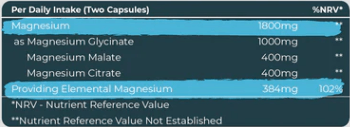
What this means is the nutrition panel is meant to be more trustworthy than the marketing claim on the front of the packaging. If the panel states magnesium in mg without naming a compound, that figure should already be elemental. If the only number you can find is the form of magnesium, i.e. magnesium glycinate, citrate and malate with asterisks (**) in the section labelled NRV and then just the total elemental magnesium compound, chances are you are consuming magnesium oxide blended with glycine.
How much magnesium you actually need, and how much is too much
UK NHS recommended intake: 300mg/day for men, 270mg/day for women aged 19–64, from diet and supplements combined¹⁴.
EFSA Adequate Intake (EU): 350mg/day for men, 300mg/day for women¹⁵.
UK safety guidance: the NHS notes that 400mg or less a day from supplements alone is unlikely to cause harm¹⁴; the UK Expert Group on Vitamins and Minerals sets the same 400mg/day figure as its guidance level for supplemental magnesium¹⁶.
EFSA tolerable upper level: a more conservative 250mg/day from supplements, based on the dose at which mild, transient diarrhoea starts to appear in sensitive individuals¹⁷.
The most common side effect of too much supplemental magnesium is diarrhoea and general GI upset; this is because unabsorbed magnesium draws water into the gut¹⁸. It's why we should care about the amount of elemental magnesium, as more isn't automatically better once you're past what your body can use.
How to check your magnesium label
How to easily check whether your magnesium is buffered or unbuffered in 3 easy steps.
None of this is a reason to distrust every magnesium product; we’ve been checking, and there are some great products out there that, like us, label their products correctly. What it is is a reason to read past the front label, the infamous Amazon’s Choice label and the questionable reviews, and for you to do these three steps, which take under a minute, and you can use our free magnesium calculator to do it:
Find the individual magnesium form: It should be on the Nutrition Information panel on the back. And add in the total amount of the magnesium form declared, i.e. 1000 mg magnesium glycinate
Add the total elemental amount: This is what most magnesium supplements declare as the total elemental amount.
Press calculate: You should see your results. Now, if there is an unexplained gap, i.e., the math doesn’t math, chances are you are holding buffered magnesium. Where a company has blended Magnesium Oxide with Glycine and called it Magnesium Glycinate, which folks, it is not.
Here is an example:
What a label should look like:
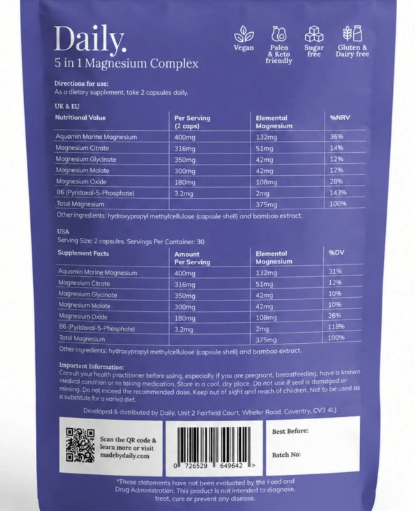
Whole Body Magnesium

£16.00
Key Benefits 5 Types of magnesium for comprehensive, whole-body support Optimised for absorption with a multi-source blend and active B6 (P-5-P) Clean formula - vegan, sugar-free, gluten & dairy-free, filler & additive-free Boosts energy metabolism & cognitive clarity Promotes restful… read more
My final thoughts on magnesium
Now you are a magnesium expert, and no marketing label, regardless of whether they are making the laughable claim that it’s created by PhD scientists (I mean, if this is true, shouldn’t they know better?). The facts are clear: bioavailability and absorption are two separate things. Understand how to read your magnesium supplement label, but most importantly, do your own research. Go past the social video, the blog post, the recommended article and read what the person has read so that you can gather your own conclusion.
To add, this is the exact reasoning behind formulating our five magnesium forms rather than a single large dose of a single magnesium form: glycinate, malate, citrate, marine, and oxide, each picked for what it contributes rather than for how big a number it lets us print on the front. We'd rather you understood what "elemental magnesium" means and asked us for our numbers than take any brand's front-of-pack figure on faith, ours included.
References
1. European Union. Directive 2002/46/EC of the European Parliament and of the Council on the approximation of the laws of the Member States relating to food supplements [Internet]. Consolidated version 2024. Available from: https://eur-lex.europa.eu/legal-content/EN/TXT/PDF/?uri=CELEX:02002L0046-20240206
2. European Union. Regulation (EU) No 1169/2011 on the provision of food information to consumers [Internet]. Available from: https://bfesse.com/regulations/chemical-salts-of-vitamins-and-minerals-eu
3. Health Britannica. Magnesium forms compared: glycinate, citrate, oxide, malate and more [Internet]. Available from: https://healthbritannica.com/articles/guides/magnesium-forms-compared/
4. MagneInno. Magnesium forms compared: glycinate, citrate, oxide, malate and threonate — a sourcing guide for supplement brands [Internet]. Available from: https://www.magneinno.com/blog/magnesium-forms-compared-glycinate-citrate-oxide-malate-and-threonate-a-sourcing-guide-for-supplement-brands
5. Accurate Clinic. Magnesium formulations: an educational guide [Internet]. Available from: https://accurateclinic.com/accurate-education-magnesium-formulations/
6. Firoz M, Graber M. Bioavailability of US commercial magnesium preparations. Magnes Res. 2001;14(4):257-262. Available from: https://pubmed.ncbi.nlm.nih.gov/11794633/
7. Kappeler D, Heimbeck I, Herpich C, et al. Higher bioavailability of magnesium citrate as compared to magnesium oxide shown by evaluation of urinary excretion and serum levels after single-dose administration in a randomized cross-over study. BMC Nutr. 2017;3:7. Available from: https://link.springer.com/article/10.1186/s40795-016-0121-3
8. Ranade VV, Somberg JC. Bioavailability and pharmacokinetics of magnesium after administration of magnesium salts to humans. Am J Ther. 2001;8(5):345-357. Available from: https://pubmed.ncbi.nlm.nih.gov/11550076/
9. Schutten JC, Joris PJ, Groendijk I, et al. Effects of magnesium citrate, magnesium oxide, and magnesium sulfate supplementation on arterial stiffness: a randomized, double-blind, placebo-controlled intervention trial. J Am Heart Assoc. 2022;11(23):e021783. Available from: https://www.ahajournals.org/doi/10.1161/JAHA.121.021783 — see also Pardo MR, Garicano Vilar E, San Mauro Martín I, Camina Martín MA. Bioavailability of magnesium food supplements: a systematic review. Nutrition. 2021;89:111294. Available from: https://pubmed.ncbi.nlm.nih.gov/34111673/
10. Blancquaert L, Vervaet C, Derave W. Predicting and testing bioavailability of magnesium supplements. Nutrients. 2019;11(7):1663. Available from: https://pmc.ncbi.nlm.nih.gov/articles/PMC6683096/
11. Schuchardt JP, Hahn A. Intestinal absorption and factors influencing bioavailability of magnesium — an update. Curr Nutr Food Sci. 2017;13(4):260-278. Available from: https://pmc.ncbi.nlm.nih.gov/articles/PMC5652077/
12. Jahnen-Dechent W, Ketteler M. Magnesium basics. Clin Kidney J. 2012;5(Suppl 1):i3-i14. Available from: https://pmc.ncbi.nlm.nih.gov/articles/PMC4455825/
13. NutraIngredients. NAD decision on magnesium gummies raises questions around compound-weight claims [Internet]. 2026 May 14. Available from: https://www.nutraingredients.com/Article/2026/05/14/nad-decision-on-magnesium-gummies-raises-questions-around-compound-weight-claims/
14. NHS. Vitamins and minerals — Others: Magnesium [Internet]. 2017 Oct 23. Available from: https://www.nhs.uk/conditions/vitamins-and-minerals/others/
15. European Food Safety Authority. EFSA sets dietary reference values for magnesium [Internet]. 2015 Jul 28. Available from: https://www.efsa.europa.eu/en/press/news/150728
16. Health Supplements Information Service. Magnesium: safety and guidance levels [Internet]. Available from: https://www.hsis.org/a-z-food-supplements/magnesium/
17. European Food Safety Authority, Scientific Committee on Food. Tolerable upper intake level of magnesium (from supplements) [Internet]. Available from: https://www.efsa.europa.eu/sites/default/files/efsa_rep/blobserver_assets/ndatolerableuil.pdf
18. National Institutes of Health, Office of Dietary Supplements. Magnesium — Health Professional Fact Sheet [Internet]. Available from: https://ods.od.nih.gov/factsheets/Magnesium-HealthProfessional/
FAQs
What is elemental magnesium?
Elemental magnesium is the actual weight of magnesium atoms in a supplement, separate from the compound (such as citrate or glycinate) it's bound to. It's the figure that determines your actual magnesium intake, and the one EU/UK law requires on nutrition labels¹².
Is magnesium glycinate the same as elemental magnesium?
No. "Magnesium glycinate" is the compound name and includes the glycine molecules it's bonded to. Elemental magnesium is only the magnesium portion of that compound, around 14% of the total compound weight³ ⁴.
Why do magnesium supplements list such high mg amounts
Because many front labels state the total compound weight (magnesium plus carrier), which is greater than the actual elemental magnesium content. A "1000mg" product might contain well under 200mg of actual magnesium, depending on the form used³ ⁴.
Is magnesium oxide or magnesium glycinate better absorbed?
It's genuinely contested. The most cited claim is that "magnesium oxide is only 4% absorbed"; this figure comes from one small study using an indirect urinary marker; other studies and reviews put oxide's absorption several times higher, and because oxide contains far more elemental magnesium per mg of compound, it can deliver a comparable or larger absolute amount of magnesium despite a lower absorption percentage. A major systematic review concludes organic forms have only a slight, inconsistent edge on average⁶ ⁸ ⁹.
How much elemental magnesium should I take per day?
UK guidance sets 300mg/day for men and 270mg/day for women from diet and supplements combined¹⁴, with 400mg/day or less from supplements considered unlikely to cause harm¹⁴ ¹⁶.